by Andrea Marcigliano
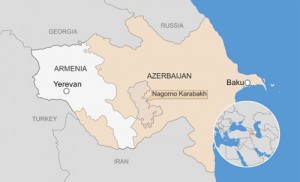 It seems, unfortunately, already proven the substantial failure of the so called “Minsk Group” to find a diplomatic solution to the continuing dispute between Azerbaijan and Armenia over Nagorno-Karabakh.
Failure attributable to the too much divergent interests among the three countries, United States, Russia and France which assume collectively the chairmanship, and which in fact, determine – or at least should determine – the guidelines. Particularly ambiguous the position of Washington, suspended, since long years by the Clinton Administration, between a Congress where the pro-Armenian positions are prevailing – so much so that the States have repeatedly committed significant funds as “aid” for the Armenian Administration of Nagorno-Karabakh – and the White House, where Clinton in the beginning and George W. Bush afterwards always tried to mediate with Baku, also, and above all, in order of avoiding to dispose essential relationships able to ensure the U.S.A. oil interests in the Caucasus. The situation, became further complicated with the election of Barack Obama, whose uncertainties and ambiguity in foreign policy are now dramatically clear to all the world’s geo-political scenarios.
In the Caucasus, then, it seems that the current U.S.A. Administration would lack any strategy, beyond the now rooted preferential relationship with Georgia. In essence it seems increasingly clear that – persisting the current uncertainty from the present Commander in Chief – prevail further the position of Congress in favour of the Armenian demands. No less ambiguous in many respects, the position of Moscow too. Even if it’s an ambiguity that not originates from the indecision of the Kremlin – it would be paradoxical to accuse of this a couple of dogs like Putin and Medvedev – but from the complicated geo-political web that Russia is weaving. As known, in fact, Moscow has strongly supported in the recent past, the secession of Nagorno-Karabakh from Azerbaijan, helping in every way the Armenia and, above all, by putting it in a position to compete militarily with the much better equipped Azeri army . A politics this, that, moreover, contradicted or better overthrew that one of the long Soviet era, when, in fact, the “Red Czars” of the Kremlin always supported the belonging of the unquiet province to the Azeri Republic.
And this also having the function of a geopolitical strategy aimed at building bridges with Turkey, a bridge consisted precisely by the Turkic-speaking Azerbaijan with its territorial integrity, including the critical juncture of Nagorno-Karabakh. An abandoned politics in the early post-Soviet years, when Moscow seemed to prevail the pro-Armenian option, by virtue of (also) religious ties – the common sense of belonging to the Orthodoxy – and depending on the containment of the Georgian influence. Anyway today, the Caucasian policy of the Kremlin might be about to experience a new evolution. In fact, the birth of the Eurasian Economic Community has necessarily approached Moscow to the Turkish-speaking Central Asian countries – notably Kazakhstan, which is the second pillar of this new reality – opening up therefore to a closer dialogue with Ankara.
Turkey is, in fact, in turn interested in the new Eurasian Common Market, for two reason, first because it is irritated by the doors repeatedly closed by the EU, and because, at the present, the entry into the euro- area appears much less interesting. So the Russian-Turkish dialogue – or between CEEu and Turkey – also opens up new scenarios for the Caucasus and, in particular, for the Nagorno-Karabakh. Still to be defined and constantly evolving scenarios, so much so that on one hand Moscow seems less perched on pro-Armenian positions and more willing to dialogue with Baku, and Ankara on the other tried to reopen channels of communication with Armenia , by softening its support for the Azeris. Stalemate, which, in the future, however, could be the harbinger of an attempt to resolve the crisis in the Azeri-Armenian inside the broader context of a common market in Eurasia. Fascinating perspective, of course, and therefore still far away.
Lastly, France, which should represent within the Minsk Group the common European interests, but which, as usual, appears rather determined by own “special” as well as by domestic issues. First of all electoral, since Paris has always been very sensitive to the pressure of the Armenian lobby in France. And therefore it’s perfectly understandable the suspicion with which Baku looks to the Minsk Group and to its latest initiatives. A suspicion that originates mainly from the consciousness of an underlying imbalance. In fact, the positions of Armenia have always been much better represented and defended inside itself, even under a lobby’s work, especially effective as in Moscow, Washington and Paris. Exercise of a kind of “soft power” that has so far overshadowed the – historical and cultural – claims of Azeris and, above all, led to downplay an objective fact. The fact that the continuation of Armenian control – according to the Azeris occupation – of the territory of Nagorno-Karabakh and surrounding provinces – a situation that has depleted Baku from almost a fifth of its territory – is so heavily impacting negatively on the economic development of not only that region but also, and above all, of the whole Caucasus. With a heavy impact on the global geo-economic scenarios. Severe, particularly for Western Europe, which should begin to look at the issue more carefully, stopping to delegate it to one, short-sighted policy of Paris.